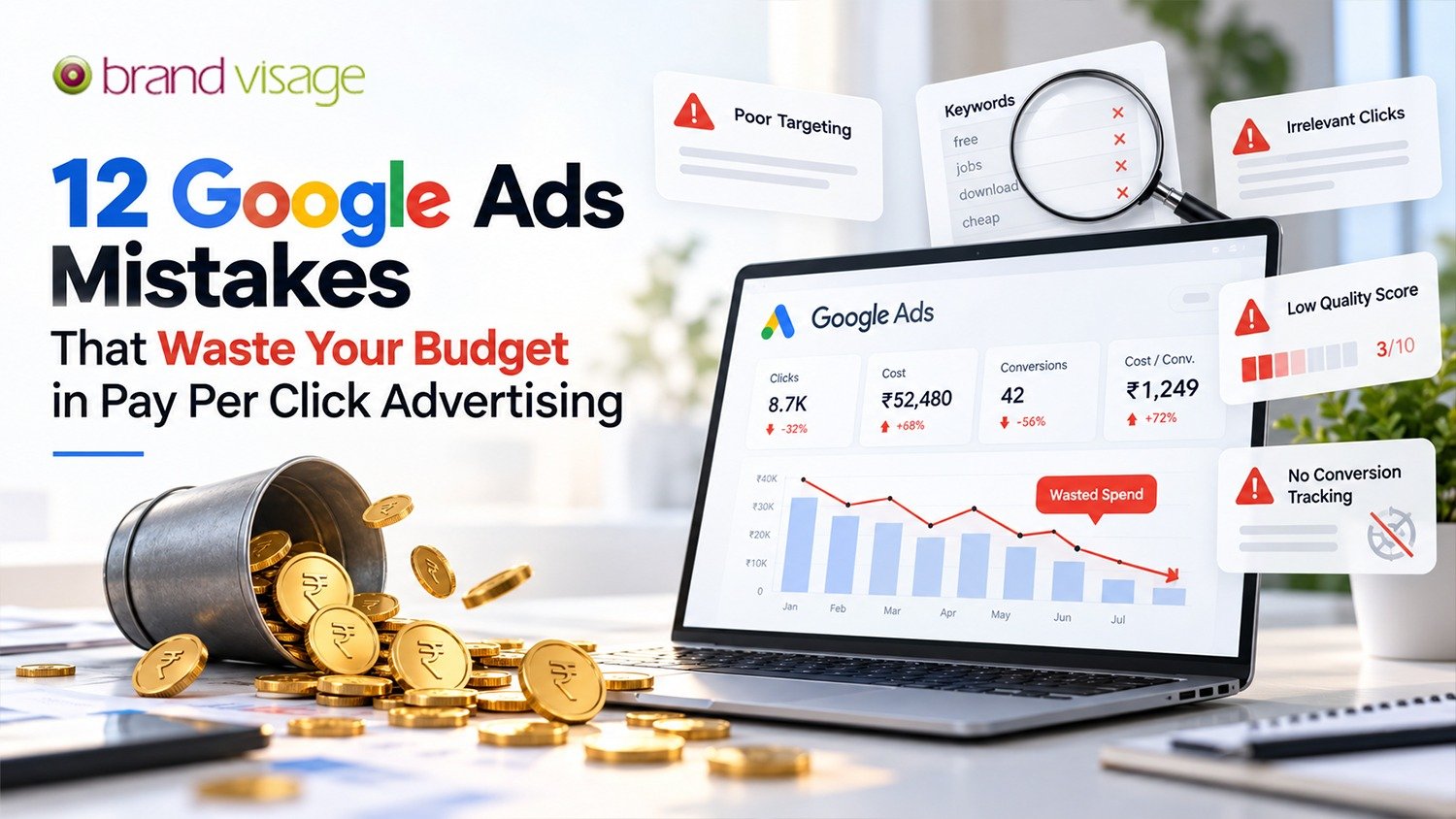
12 Google Ads Mistakes That Waste Your PPC Budget
You set up a Google Ads campaign, fix a budget, and wait for the inquiries to arrive. The clicks come in, and the money gets spent, but the leads barely show up.
If that sounds familiar, the budget may not be the problem. The way the campaign is set up often is. In pay-per-click advertising, you pay for every click, so when your ads reach the wrong people or send them to the wrong page, the money goes quickly.
Here are 12 common Google Ads mistakes to check before you spend another rupee.
1. Choosing keywords that are too broad
If you sell office chairs and bid on the word “chairs,” you may get clicks from people looking for dining chairs, plastic chairs, or chair repair. Most of them have no interest in what you sell.
Pick keywords that match your product or service closely. Then open the search terms report every so often and read what people actually typed before they clicked your ad. It is usually an eye-opener.
2. Ignoring negative keywords
Negative keywords tell Google which searches you don’t want your ads to appear for. If you sell paid online courses, searches that include “free” are unlikely to turn into customers.
Without a negative keyword list, your ads can appear for plenty of searches with little chance of a sale. Go through your search terms, and keep adding the irrelevant ones to the list.
3. Sending everyone to the same landing page
Picture clicking an ad for one specific service and landing on a homepage that lists ten. Now you have to hunt for the information yourself, and many people won’t bother.
Send visitors to a page that matches the ad they clicked. If the ad is about website design, the landing page should be about website design.
4. Writing ads that say very little
“Quality Service. Best Prices. Contact Us Today.” You’ve seen ads like this, and the problem is that almost any business could have written them.
Say what you actually offer. Mention a benefit that matters to the customer, explain what makes your service useful,, and give a clear next step. The ad doesn’t have to be clever. It has to give the right person a reason to click.
5. Forgetting to track conversions
Clicks look good in a report, but on their own they don’t tell you whether the campaign works. Are people filling in your enquiry form, calling you or buying something?
Set up conversion tracking before you launch, not after. If you add it later, you lose the early data and have no way to tell which of your first few weeks of spend brought in real business.
6. Using the same budget for every campaign
Not every campaign deserves the same money. One may bring in steady inquiries, while another spends its budget and produces nothing. Splitting the budget equally because it feels fair doesn’t make much sense.
Look at performance before you move money around. Compare lead quality, cost per conversion, and the value of the customers each campaign brings in.
7. Targeting too many locations
If you only serve customers in Delhi NCR, showing ads across India wastes money. Set your location targeting to the places where you can sell or deliver your service.
Also check the location option in your campaign settings. Google Ads can target people who are in your chosen area or people who are merely interested in it, and the second option can show your ads to people far outside the area you meant to reach. A smaller, relevant audience usually beats a large one that will never buy.
8. Letting campaigns run without checking them
Launching a campaign is not the end of the job. Search behaviour changes, competitors rewrite their ads and some keywords stop working the way they used to.
Look at your search terms, spend, conversions and overall performance on a regular schedule. You don’t have to change things every day, but you should always know where your money is going.
9. Ignoring mobile users
Many people will click your ad on a phone while travelling or taking a break. If the landing page loads slowly or the enquiry form is awkward to fill in, they’ll leave.
Open your landing pages on a phone and try them yourself. Check that the main information is easy to find and that buttons and forms work properly.
10. Making changes without enough data
A keyword gets a few clicks and no lead, so you pause it. Another campaign has one good day, so you double its budget. Both decisions can backfire.
A small amount of data rarely tells the full story. Give each campaign enough time and enough clicks to judge it fairly, and keep your budget and your usual sales cycle in mind. A service that takes two weeks to close won’t show results in three days.
11. Focusing only on cheap clicks
A low cost per click looks attractive, but cheap traffic isn’t always useful traffic. Say one campaign brings visitors at ?10 a click but no enquiries, while another costs ?40 a click and brings qualified leads. The second one is the better investment.
Look at what happens after the click. The aim is not to pay less for traffic. It is to attract people who are more likely to become customers.
12. Accepting Google’s automatic recommendations without a second look
Google Ads regularly suggests changes to your campaigns, such as new keywords, wider targeting or higher budgets. Some of these suggestions help. Others mainly increase how much you spend.
Read each recommendation before you accept it, and turn off auto-applied recommendations unless you’re sure you want them. If you don’t have the time or experience to judge them, a PPC expert can tell you which suggestions fit your goals and which to ignore.
Getting more from your Google Ads budget
You don’t always need to spend more to improve results. Often the better move is to stop paying for irrelevant clicks, fix a weak landing page or improve how you track leads.
Brand Visage Communications is a digital marketing agency that offers performance marketing alongside SEO, website development, and social media marketing.
If you’re thinking about hiring a PPC company, a good one should be able to explain what it is changing and why. You should be able to see how your budget is being used and what the results mean for your business. Be careful with anyone who guarantees results or leads, because nobody can promise that on Google Ads.
Not sure where your budget is going? Contact us, and we’ll point out where you may be losing money. You can also see more about our performance marketing services.
The important thing is to look beyond the number of clicks and check whether they’re bringing the right people to your business. In pay-per-click advertising, spending the budget is easy. Making it count takes more work.
Frequently asked questions
1. What is pay-per-click advertising, and how does it work?
Pay per click advertising is a form of online advertising where you pay when someone clicks your ad. With Google Ads, you can show ads to people searching for products or services related to your business. Your spend depends on your bids, your competition and your campaign settings.
2. What are the most common pay-per-click advertising mistakes?
The usual ones are broad keywords, no negative keywords, sending visitors to the wrong landing page and not tracking conversions. Poor targeting and leaving campaigns unchecked also waste budget.
3. How can businesses avoid wasting money on Google Ads?
Start with relevant keywords and clear campaign goals. Check your search terms regularly and stop paying for searches that don’t match your services. Make sure your landing pages work properly, and track enquiries, calls or sales so you can see what is really working.
4. What are some examples of pay per click advertising?
Google search ads are the most familiar example. Others include shopping ads, display ads and YouTube ads. Businesses can also run PPC campaigns on platforms such as Microsoft Ads, depending on where their customers spend time online.
5. How do you choose the right keywords for a PPC campaign?
Think about what a potential customer would type when looking for your product or service. Use specific keywords that match their needs, check search intent and look at estimated costs and competition. A PPC expert can also spot irrelevant searches early, before they use up too much of your budget.
6. Why are negative keywords important in pay per click advertising?
Negative keywords stop your ads from showing for certain irrelevant searches. A business selling premium paid courses, for example, may want to exclude searches for free courses. They cut unwanted clicks and keep your budget focused on people more likely to buy.
7. How can a business improve its Google Ads conversion rate?
Make sure your ad matches the page visitors land on. Keep the main message clear, make your contact details easy to find, and remove unnecessary steps from forms or checkout pages. Test different headlines and calls to action to see what encourages more people to inquire or buy.
8. What is the average cost of pay-per-click advertising in India?
There is no single average that fits every business. In India a click can cost a few rupees in some campaigns and a lot more in competitive industries. The price depends on the keyword, the competition, the location and other auction factors. Check your own campaign data before you decide whether your cost per click is reasonable.
9. How can you reduce cost per click (CPC) in Google Ads?
Start by improving keyword relevance and making sure your ads match what people are searching for. Improve your landing pages and remove irrelevant search terms. Avoid lowering bids blindly, because cheaper clicks aren’t better if they bring fewer qualified leads.
10. How do you measure the ROI of a pay per click advertising campaign?
Compare the revenue the campaign generated with the total cost of running it. For a simple calculation, subtract the campaign cost from the revenue attributed to it, divide the result by the campaign cost, and multiply by 100. Take lead quality and actual sales into account, not just clicks.
11. What should you look for when hiring a pay per click advertising firm?
Look for a team that understands your business goals and explains its approach clearly. Ask how it tracks conversions, manages budgets and reports results. A reliable PPC company should be able to tell you what it is doing and why and should not promise guaranteed results.
12. Is hiring a pay-per-click advertising agency worth the investment?
It can be, especially if you need expert campaign management or don’t have the time to handle it yourself. A good agency can help with targeting, ad testing, conversion tracking and budget management. Compare its fees with the potential value of better leads and sales before you decide, and consider a performance marketing company if you want reporting tied closely to your business goals.
13. What is the difference between Google Ads and other PPC platforms?
Google Ads can reach people searching for products and services on Google, as well as audiences across other Google advertising placements. Platforms such as Microsoft Ads, Meta Ads, and LinkedIn Ads offer different ways to reach people. The right choice depends on your audience, your goals, and your budget.
14. How can poor landing pages waste your PPC budget?
Someone may click your ad because they like your offer, then leave because the page loads slowly or doesn’t have the information they expected. You still pay for that click. Keep the page relevant to the ad, explain the offer clearly, and make the next step easy.
15. How often should you optimize a pay-per-click advertising campaign?
Check campaign performance regularly, ideally at least once a week, depending on your budget and activity. Look at search terms, spend, conversions, and lead quality. Make bigger changes once you have enough data to support them, rather than reacting to every short-term swing.

You may also like

How to Do SEO for a Website: A Practical Guide for Beginners